Deciphering the role of bacterial secreted effectors: why is Brucella going nuclear?
Date: Monday, 18 May 2026
Time: 3pm – 4pm
Venue: SBS CR4 (SBS-01n-24)
Abstract:
Brucella is a highly pathogenic bacterium responsible for one of the most widespread zoonotic diseases worldwide. A key feature of its virulence is its remarkable capacity to replicate intracellularly by injecting bacterial effector proteins into host cells. Depending on the tissue context, this can lead to very different outcomes with either chronic, debilitating disease or inflammatory tissue damage. How Brucella modulates host cellular responses in these different contexts remains unknown. Our team has identified several Brucella effectors that directly interfere with innate immune pathways to persist in the host or target the host nucleus to perturb tissue integrity. In this presentation, I will discuss our most recent findings on how these effectors contribute to the pathology associated with Brucella infection.
Speaker:
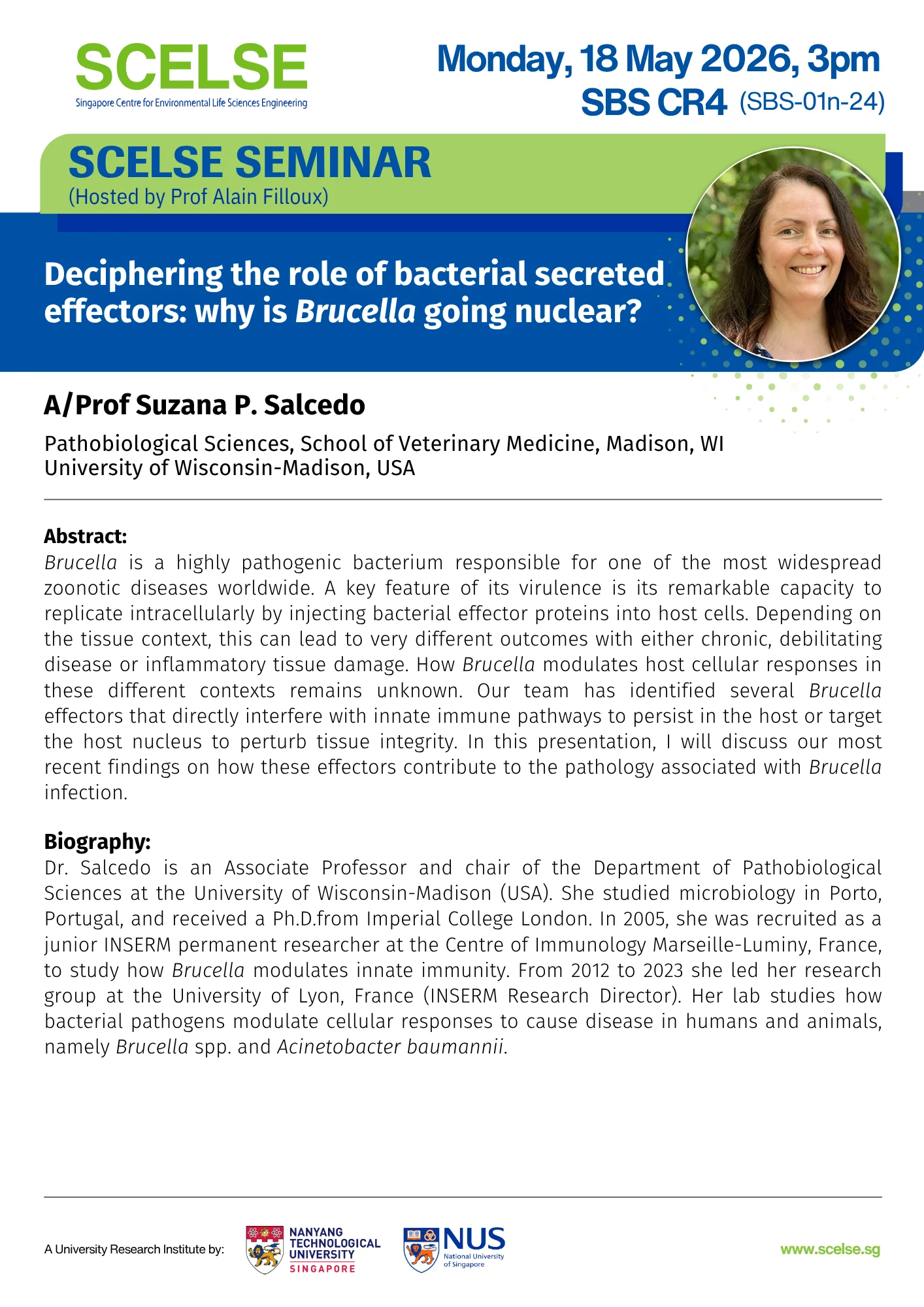
A/Prof Suzana P. Salcedo
Pathobiological Sciences, School of Veterinary Medicine, Madison, WI
University of Wisconsin-Madison, USA
Biography:
Dr. Salcedo is an Associate Professor and chair of the Department of Pathobiological Sciences at the University of Wisconsin-Madison (USA). She studied microbiology in Porto, Portugal, and received a Ph.D.from Imperial College London. In 2005, she was recruited as a junior INSERM permanent researcher at the Centre of Immunology Marseille-Luminy, France, to study how Brucella modulates innate immunity. From 2012 to 2023 she led her research group at the University of Lyon, France (INSERM Research Director). Her lab studies how bacterial pathogens modulate cellular responses to cause disease in humans and animals, namely Brucella spp. and Acinetobacter baumannii.