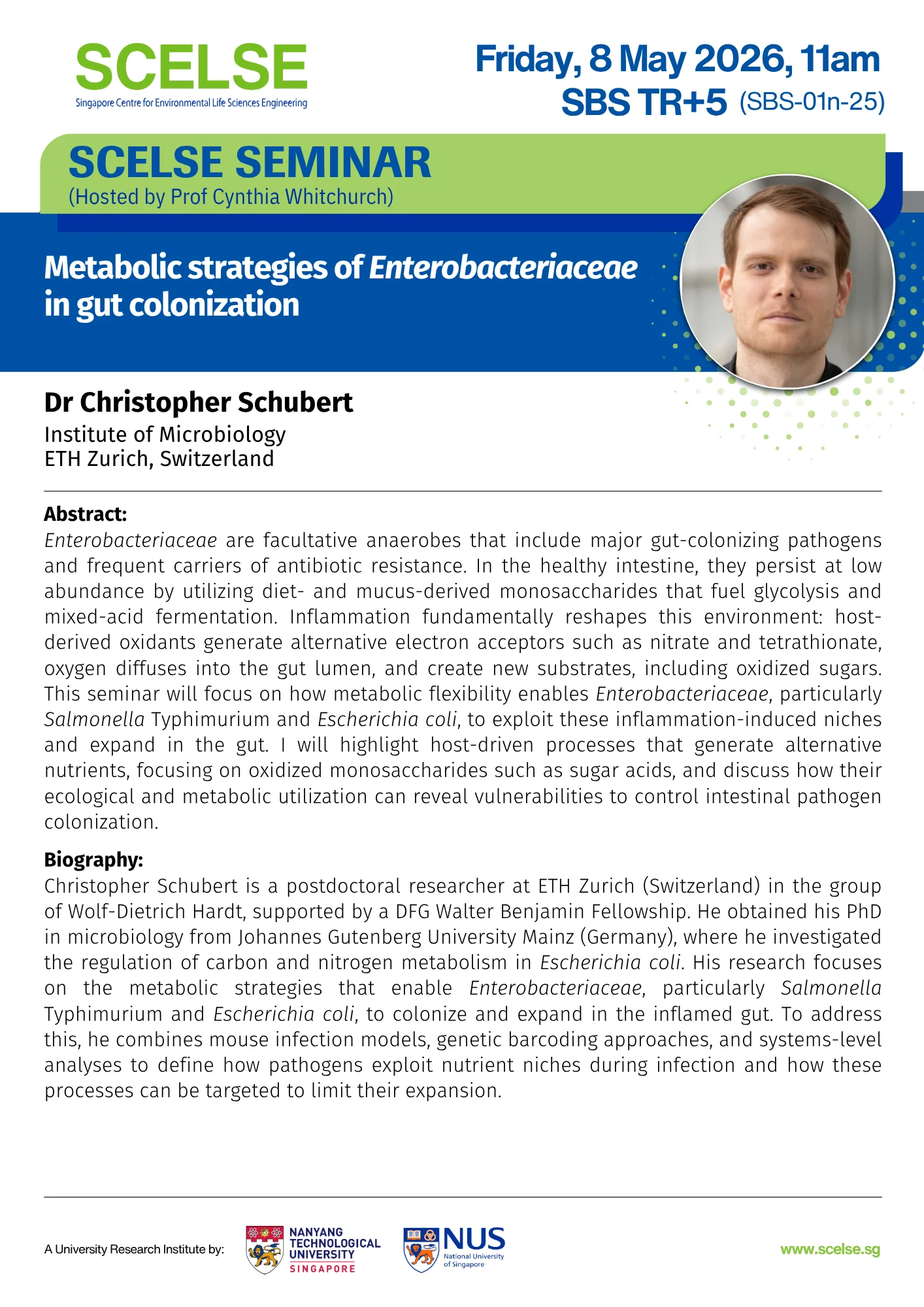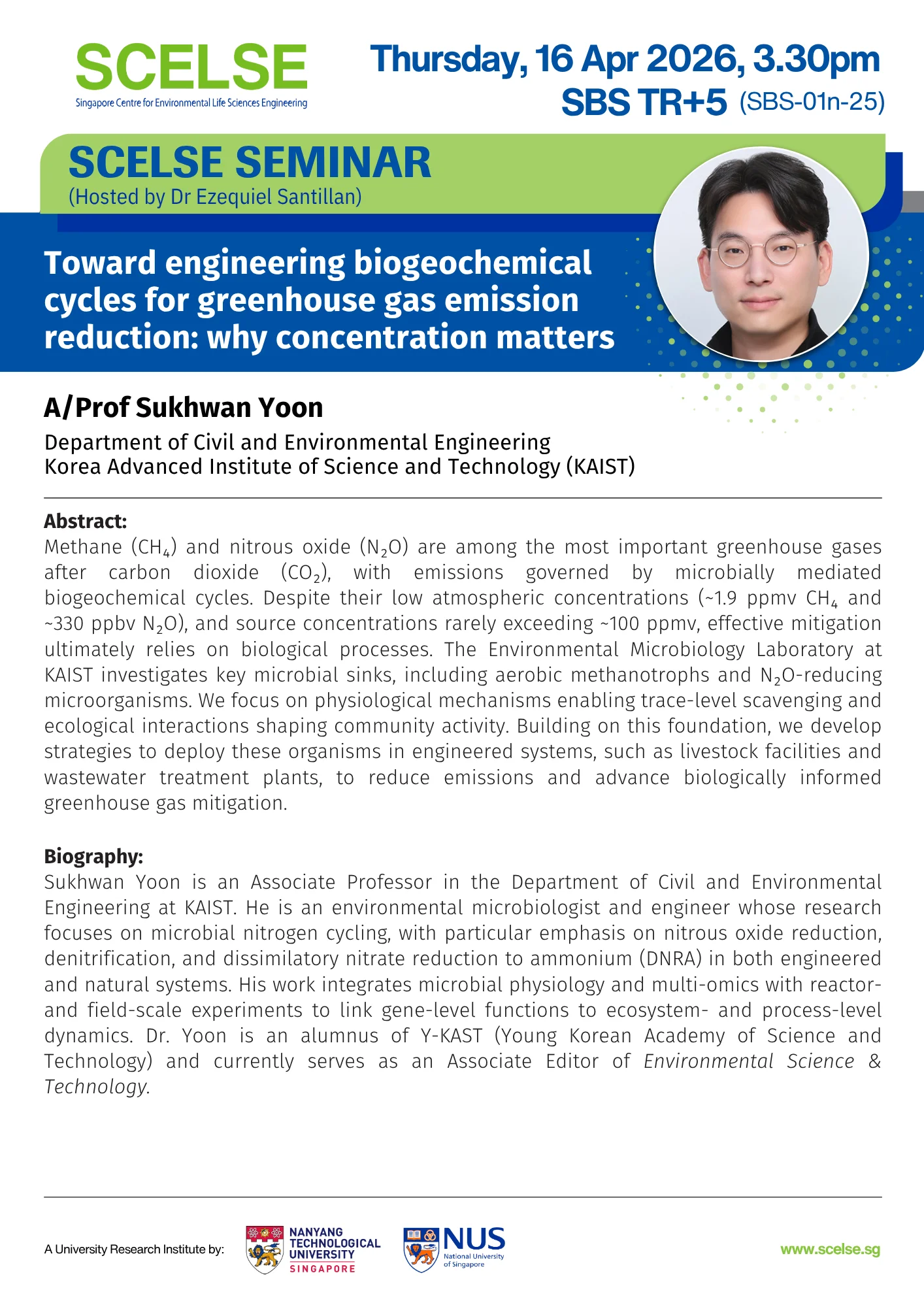
Microbial amendments to mitigate greenhouse gas emissions from wetland ecosystems
Date: Thursday, 16 Apr 2026
Time: 10am – 11am
Venue: SBS TR+6 (SBS-01n-26)
Abstract:
Control of methane and nitrous oxide emissions in wetlands relies on modulating the activity and composition of microbial communities, and their local environment, to promote methane oxidation over methanogenesis and plant N-uptake over microbial N-cycling. We are developing strategies to both augment aerobic methanotrophic communities by creating deployable living materials, and inhibit nitrifying microbes that compete with plants for N-fertilizer and produce nitrous oxide. These strategies rely on microbial isolation, genome-inferred and growth optimized construction of synthetic communities embedded in hydrogel matrices, screening of plant root exudates for biological nitrification inhibitors (BNIs), isolating lytic phage against ammonia-oxidizing bacteria, and ensuring that deployment of microbial interventions in the field does not incur harm to the soil microbiome or essential ecosystem services. Thus far, we have successfully encapsulated and grown methanotrophic bacteria in hydrogel matrices and demonstrated their reliance on the oxygen-binding protein, bacteriohemerythrin, in both forming and sustaining their biofilm growth. We have isolated diverse methanotrophs, methylotrophs and heterotrophs from a methane-impacted freshwater system to create novel ‘syncoms’ with diverse phototrophs using a high throughput growth platform. We have developed a rapid assay for root exudate preparation and BNI screening that can be applied to rice to identify lines with strong BNI traits. Our early results on wheat root exudates show that BNI-producing lines mainly stimulate methanotrophs while inhibiting ammonia-oxidizers, which means both methane and nitrous oxide emissions can be controlled by the same line. If similar results can be discovered in BNI producing rice, these varieties could simultaneously reduce GHG emission and improve nitrogen use efficiency without further intervention. Field testing of our methanotrophic living materials, screening rice germplasm using our rapid BNI assay, and testing lytic phage that target ammonia-oxidizing bacteria would greatly accelerate progress in developing and deploying novel microbiome solutions for GHG and nitrogen management in flooded ecosystems.
Speaker:
Prof Lisa Y. Stein
Faculty of Science – Administration, Associate Dean,
Faculty of Science – Administration,
University of Alberta, Canada;
Canada Research Chair in Climate Change Microbiology;
Editor in Chief, The ISME Journal
Biography:
Lisa Stein’s research focuses on the physiology, genomics, and ecology of nitrification, denitrification, and single carbon metabolism. Her work aims to understand the influence of microbial metabolism on greenhouse gas production. Applied work is aimed at industrialization of microorganisms using single-carbon feedstocks and increasing nitrogen use efficiency in crops by inhibiting nitrification.