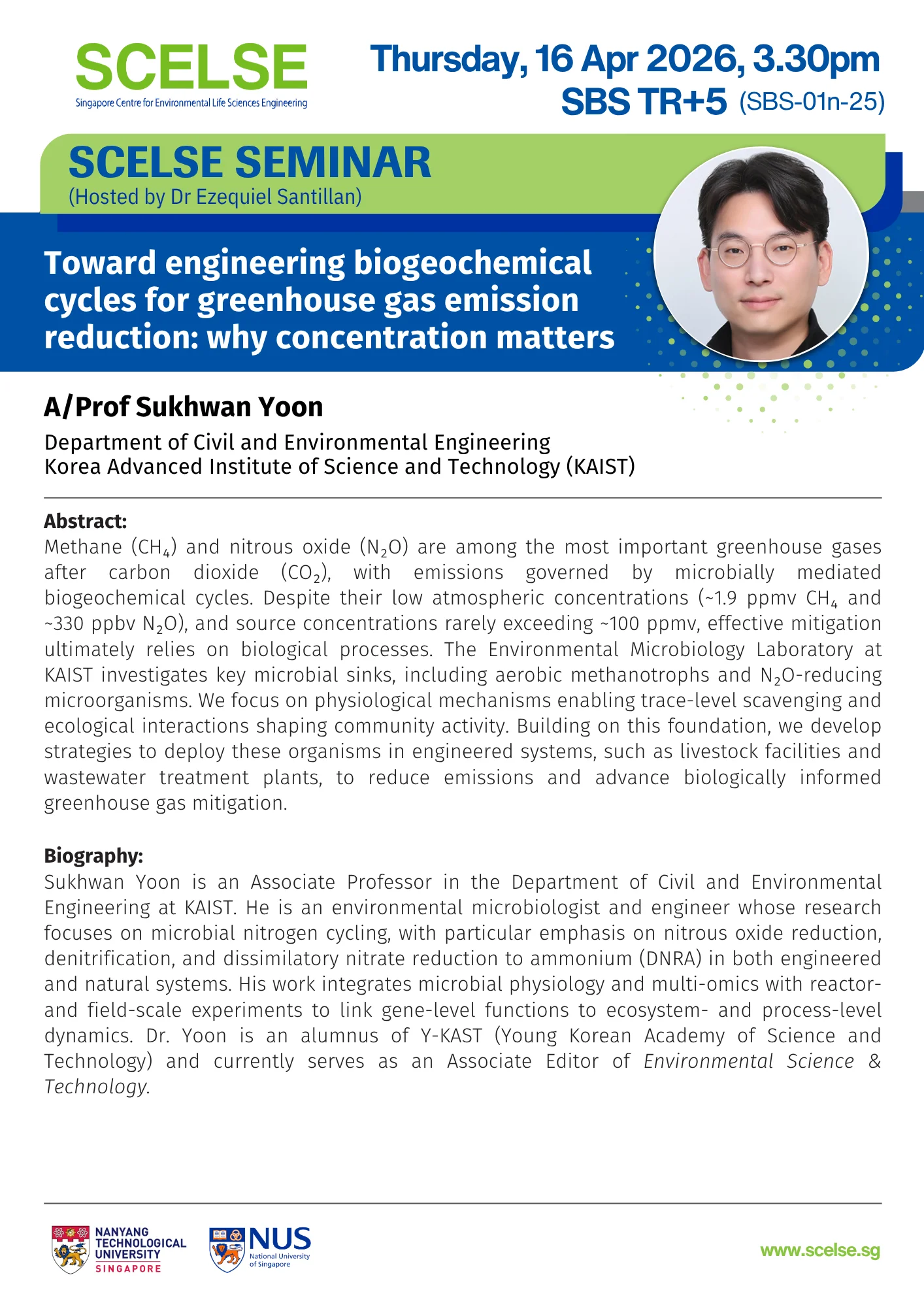
Toward engineering biogeochemical cycles for greenhouse gas emission reduction: why concentration matters
Date: Thursday, 16 Apr 2026
Time: 3.30pm –4.30pm
Venue: SBS TR+5 (SBS-01n-25)
Abstract:
Methane (CH₄) and nitrous oxide (N₂O) are among the most important greenhouse gases after carbon dioxide (CO₂), with emissions governed by microbially mediated biogeochemical cycles. Despite their low atmospheric concentrations (~1.9 ppmv CH₄ and ~330 ppbv N₂O), and source concentrations rarely exceeding ~100 ppmv, effective mitigation ultimately relies on biological processes. The Environmental Microbiology Laboratory at KAIST investigates key microbial sinks, including aerobic methanotrophs and N₂O-reducing microorganisms. We focus on physiological mechanisms enabling trace-level scavenging and ecological interactions shaping community activity. Building on this foundation, we develop strategies to deploy these organisms in engineered systems, such as livestock facilities and wastewater treatment plants, to reduce emissions and advance biologically informed greenhouse gas mitigation.
Speaker:
A/Prof Sukhwan Yoon
Department of Civil and Environmental Engineering
Korea Advanced Institute of Science and Technology (KAIST)
Biography:
Sukhwan Yoon is an Associate Professor in the Department of Civil and Environmental Engineering at KAIST. He is an environmental microbiologist and engineer whose research focuses on microbial nitrogen cycling, with particular emphasis on nitrous oxide reduction, denitrification, and dissimilatory nitrate reduction to ammonium (DNRA) in both engineered and natural systems. His work integrates microbial physiology and multi-omics with reactor- and field-scale experiments to link gene-level functions to ecosystem- and process-level dynamics. Dr. Yoon is an alumnus of Y-KAST (Young Korean Academy of Science and Technology) and currently serves as an Associate Editor of Environmental Science & Technology.